Quick Answer
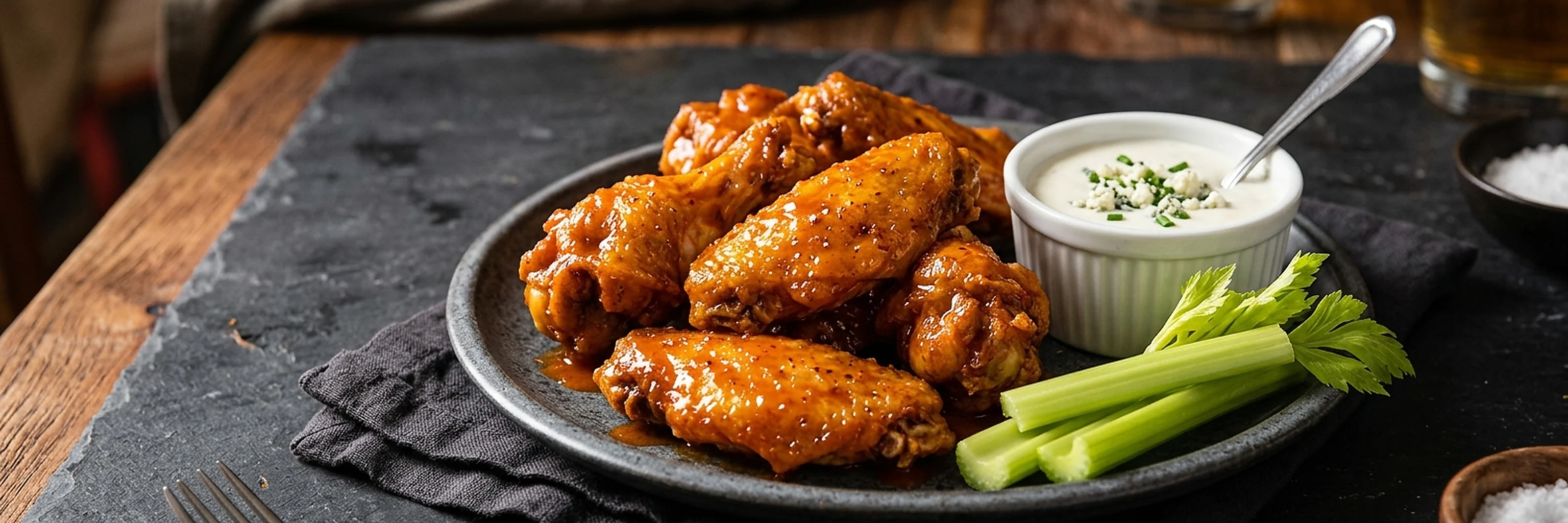
How do buffalo wing pairings differ by region?Buffalo wings vary significantly by region in both sauce preference and accompaniments. Buffalo, NY — the origin city — demands blue cheese dressing, celery sticks, and a medium-heat cayenne-forward sauce. The South strongly prefers ranch over blue cheese and leans toward sweeter sauce variations. The Midwest is most loyal to Frank's RedHot-style sauces with beer as the universal pairing. The West Coast has embraced creative fusion variations, craft beer pairings, and alternative dipping sauces including avocado-based options. Carrot sticks appear more commonly in the Midwest and West as an alternative to celery.
Buffalo, New York: The Original Standard
Buffalo, NY has opinions about its namesake dish, and those opinions are strong. The original Anchor Bar version — and virtually every serious Buffalo wing establishment — holds to specific pairing standards that have persisted since 1964:
- Blue cheese dressing exclusively: Ranch dressing at a Buffalo wing establishment in the city is considered an offense. The local blue cheese is typically homemade, chunky, made with real Maytag or Bleu Castello crumbles, and considerably more assertive than bottled versions.
- Celery stalks: Always celery, never (or almost never) carrots. The celery serves a dual function — flavor contrast and palate cleanser between bites. The bitterness of raw celery cuts the butter richness in a way carrots don't.
- Medium heat as default: Despite Buffalo being the hot sauce capital, most establishments in the city consider "medium" the canonical heat level. The Frank's RedHot + butter ratio is fairly butter-forward — the sauce has good heat without overwhelming.
- Beer pairing: Local brews are preferred, but the pairing logic is practical — cold, light lager or amber ale. Buffalo has a strong Labatt Blue culture (the Canadian lager) and local craft options from Community Beer Works and Flying Bison Brewing.
💡 What Buffalo Wing Purists Get Right
The blue cheese + celery pairing with classic medium buffalo sauce is genuinely well-engineered. Blue cheese's fat and umami complement the butter-forward sauce; the funky fermented notes of the cheese play off the fermented pepper flavor of the hot sauce. Celery's crunch and slight bitterness contrast the richness. The three elements balance each other across a plate of wings in a way that ranch + carrots doesn't quite replicate. This is why it became the standard.
The South: Ranch Country and Sweet Heat
Southern states — particularly Texas, Tennessee, Georgia, and the Carolinas — have developed their own wing culture that diverges significantly from the Buffalo original:
- Ranch dressing dominates: Ranch is the default dipping sauce across virtually all Southern wing establishments. Blue cheese is available but considered a specialty item rather than standard. The Southern ranch is often buttermilk-based, tangier, and slightly thicker than national bottled versions.
- Sweet heat variations: The South's barbecue tradition has influenced wing sauce development. Honey-sriracha, sweet chili, and bourbon-brown sugar variations are as popular as classic buffalo. The sweet-heat profile comes naturally from the barbecue tradition.
- Carrot sticks included: Many Southern wing operations include both celery and carrots, or carrots alone. The addition of carrots has Texas roots — their slight sweetness pairs naturally with the sweeter sauce profiles.
- Beer pairing: Light domestic lager (Bud Light, Coors Light, Miller Lite) remains the dominant pairing. Texas craft brewing has added IPA pairings that work well with the sweet-heat Southern profiles — the bitterness of an IPA cuts through the sweetness in a way lager doesn't.
- Frying style: Southern wing establishments often fry wings at slightly higher temperatures, producing a crisper skin. The extra crunch stands up to thicker, sweeter sauces that might otherwise make the coating soggy.
The Midwest: Frank's Loyalty and the Sports Bar Standard
The Midwest — Ohio, Illinois, Michigan, Indiana — represents the largest single market for buffalo wings in the country (by consumption per capita of chicken wings). The regional style is:
- Frank's RedHot loyalty: The Midwest is Frank's RedHot territory more strongly than any other region. Buffalo Wild Wings, headquartered in Minneapolis, has built a national franchise culture that has reinforced Frank's-style sauces as the standard. Deviation from Frank's-adjacent flavor profiles is less accepted in the Midwest than elsewhere.
- Sports bar context: More than any other region, Midwestern wing culture is tied to sports bar viewing. Wings are ordered in multiples of 10 or 12, eaten over the course of a game, alongside pitchers of beer.
- Ranch as acceptable alternative: The Midwest is divided — blue cheese is still considered appropriate (and loyal to Buffalo tradition) but ranch has made more inroads here than in the Northeast.
- Nachos and fries as sides: Unlike the original Buffalo style (wings + celery + blue cheese, that's it), Midwestern wing nights involve a full spread: nachos, fries, mozzarella sticks alongside the wings.
- Beer pairing: Great Lakes Brewing (Cleveland), Bell's Brewery (Michigan), Goose Island (Chicago) represent the craft options, but domestic light lager remains dominant in the sports bar context.
West Coast: Fusion and Craft Pairing
The West Coast (California, Oregon, Washington) has embraced buffalo wings within a broader creative food culture that has produced notable regional variations:
- Fusion variations widely accepted: Korean-style gochujang buffalo, yuzu-citrus buffalo, mango-habanero buffalo — West Coast menus are significantly more experimental with sauce profiles. The food culture is less nostalgic about the "original" form.
- Both ranch and blue cheese: The West Coast doesn't have the strong regional preference of Buffalo (blue cheese) or the South (ranch). Many establishments offer both as standard. Avocado-based dipping sauces appear as a third option, particularly in California.
- Craft beer as serious pairing: California, Oregon, and Washington have the most sophisticated craft beer culture in the country. IPAs, sours, and farmhouse ales are genuinely considered and matched with wing sauce heat levels at better establishments. The pairing conversation that happens casually is more developed on the West Coast.
- Carrots standard, celery included: Both are typically included. The crudité plate is fuller — sometimes including cucumber or radish alongside celery and carrots.
| Region | Dip | Default Sauce | Beer Pairing | Sides |
|---|---|---|---|---|
| Buffalo, NY | Blue cheese only | Medium Frank's + butter | Labatt Blue, local craft | Celery stalks only |
| South (TX, TN, GA) | Ranch dominant | Sweet heat, honey buffalo | Light domestic lager | Carrots + celery |
| Midwest (OH, IL, MI) | Ranch or blue cheese | Frank's-style medium | Domestic lager, sports bar | Fries, nachos, full spread |
| West Coast (CA, OR, WA) | Both, sometimes avocado | Varied, fusion accepted | Craft IPA, farmhouse ale | Celery + carrots + cucumber |
| Northeast (excl. Buffalo) | Blue cheese lean | Medium to hot buffalo | East Coast craft, lager | Celery + carrots |
What These Differences Tell Us
Regional variation in buffalo wing pairing follows predictable cultural food logic:
- Ranch vs. blue cheese follows the national ranch vs. blue cheese divide: Ranch is the dominant salad dressing in the South and Midwest; blue cheese is stronger in the Northeast. The wing dip mirrors the regional salad dressing preference.
- Sweet heat is a Southern BBQ translation: The South's expertise in sweet-smoky-spicy flavor from barbecue naturally mapped onto wing sauce. Honey buffalo is a Southern-influenced variation of the original concept.
- Frank's dominance is a marketing success story: Frank's aggressive co-marketing with Buffalo Wild Wings and its presence as the default hot sauce at most sports bars nationwide has cemented its position in the Midwest and throughout the country, even as craft hot sauce culture has created alternatives.
- The West Coast's fusion openness reflects broader food culture: Los Angeles, San Francisco, and Portland have restaurant food cultures that prize novelty and international influence. This shows up in wing sauce as clearly as anywhere else in their menus.