Quick Answer
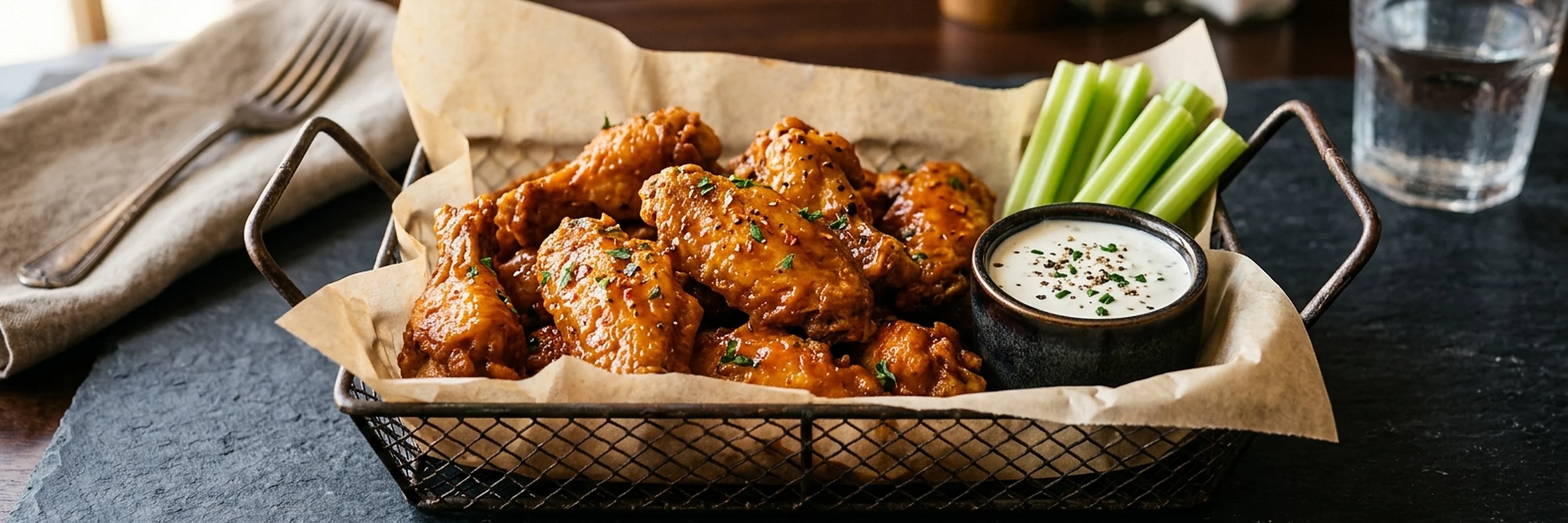
Why do air fryer wings come out crispier than oven wings?Air fryers produce crispier wings than standard ovens through two mechanisms: (1) Higher convective velocity — air fryers circulate air at very high speed around the food, dramatically increasing heat transfer rate compared to even convection ovens; (2) Lower humidity environment — the small enclosed chamber of an air fryer allows the moisture evaporating from wings to be continuously cycled away, keeping humidity low and promoting dehydration of the skin surface. Standard ovens (even convection) have larger chambers where moisture accumulates. The result: air fryers achieve the rapid surface dehydration needed for crispiness in 20–25 minutes that oven methods require 45–55 minutes to approach. Deep frying still outperforms both, but air fryers come significantly closer to fried texture than ovens.
Why Cooking Method Changes Crispiness
Crispy chicken skin requires two things: high surface temperatures (above 280°F for Maillard browning) and rapid dehydration of the skin surface. Different cooking methods deliver these to different degrees.
The key physics: heat transfers from the cooking environment to the food surface through three mechanisms:
- Conduction: Direct contact transfer (pan contact, touching a rack)
- Radiation: Infrared heat from the heating elements directly
- Convection: Hot air or liquid moving past the food surface, delivering heat by contact
Deep frying works so well because hot oil provides both very high surface temperatures (350°F+) and extremely efficient conduction/convection simultaneously — oil is 800 times more thermally conductive than air at the same temperature. Air fryers close some of this gap by using very high-velocity air. Standard ovens use slow-moving hot air, the least efficient heat transfer method.
The Science of Air Fryer Cooking
An air fryer is essentially a small convection oven with an exceptionally powerful fan and minimal cooking chamber volume. These two features combine to create unusual cooking conditions:
- High air velocity: Air fryer fans move air at much higher velocities than traditional convection ovens. The faster air moves past the food surface, the more efficiently heat is transferred — this is the same principle behind wind chill (faster wind = faster body heat loss). High-velocity air also removes the thin boundary layer of humid air that forms against the food surface, allowing faster moisture evaporation.
- Small chamber volume: The compact cooking chamber means the relative proportion of food to air is high. Moisture evaporating from the food is quickly exchanged with the continuous airflow — humidity doesn't build up the way it does in a large oven cavity.
- Proximity to heating element: Food in an air fryer sits closer to the heating element than in a large oven, receiving more direct radiant heat. This supplements the convective heat transfer and contributes to faster surface browning.
- Temperature accuracy: The small thermal mass of the air fryer chamber means it reaches set temperature quickly and maintains it accurately. Larger ovens take longer to preheat and may have more temperature variation across the cooking space.
The combined effect: air fryers deliver heat to wing surfaces at 2–3x the rate of conventional ovens, and remove moisture from the skin surface more aggressively. This is why air fryer wings are significantly crispier than oven wings in half the cooking time.
The Science of Oven Cooking
Standard ovens are much larger chambers with slower air movement — even conventional convection settings move air at a fraction of air fryer velocity. The cooking physics:
- Slower heat transfer: Slower-moving air is less efficient at transferring heat to the food surface. More time is required to achieve the same surface temperatures.
- Humidity accumulation: The larger oven chamber allows moisture evaporating from the wings to build up, increasing local humidity near the food. Higher humidity slows further moisture evaporation from the skin (the same reason clothes dry slower on humid days).
- Temperature gradients: Larger ovens have temperature variations across the cooking space. Wings near the heating element brown faster than wings further away; rotating the pan partway through helps but doesn't fully equalize.
- Pan choice matters more: Because heat transfer is slower, the choice of pan (wire rack vs. flat sheet) makes a significant difference in oven cooking. Wire racks allow air circulation under the wings; flat pans trap steam below them, preventing bottom-side crisping.
The good news: oven wings can be excellent with the right technique modifications. They require more prep (dried wings, baking powder) and more time, but can approach air fryer quality with the right approach.
| Factor | Air Fryer | Convection Oven | Standard Oven |
|---|---|---|---|
| Air velocity | Very high (100+ CFM) | Moderate (10–30 CFM) | Near-zero (natural convection) |
| Chamber humidity | Low — rapid air exchange | Moderate | High — moisture accumulates |
| Surface temp achieved | 280–320°F | 260–300°F | 220–270°F |
| Time to golden-crispy wings | 20–25 min | 35–45 min | 50–60 min |
| Crispiness vs. deep fry | ~80% comparable | ~65% comparable | ~50% comparable |
| Batch size limitation | Significant — 1 layer only | Moderate | Large batches possible |
| Cleanup | Easy | Moderate | Easy |
Optimizing Each Method
For air fryer wings:
- Don't overcrowd — single layer only, with space between wings. Overcrowding re-introduces the humidity problem by trapping steam between wings.
- Flip halfway — even air fryers have hot spots and uneven air distribution. Flipping at the halfway point ensures both sides get direct exposure to the highest-velocity airflow.
- Pat dry or overnight fridge dry — even with the air fryer's efficiency advantage, starting with drier skin produces better results.
- 400°F for 20–25 minutes is the standard; adjust down to 380°F for very large wings that need more cook time without burning the surface.
For oven wings:
- Wire rack essential — elevating wings allows air and heat to circulate on all sides and lets rendered fat drip away.
- Baking powder treatment — adds significant crispiness benefit in oven cooking where the surface temperature advantage is limited.
- High heat: 425–450°F. The oven's larger thermal mass handles higher set temperatures without burning the surface.
- Overnight refrigerator drying is more important for oven wings than air fryer wings — the oven's humidity environment makes starting with dry skin even more critical.
- Final broil: 2–3 minutes under the broiler after the main cook crisps the top surface significantly. Watch carefully — it goes from perfect to burnt quickly.
💡 The Two-Stage Oven Method
The best oven wing technique for near-air-fryer results: cook at 375°F on a wire rack for 30 minutes (renders the fat and begins browning), then increase to 450°F for the final 15–20 minutes (drives the surface to high-Maillard temperatures). This two-stage approach avoids the problem of surface burning before fat renders that can happen at pure high heat, while still achieving the high surface temperatures needed for crispiness in the finish phase.