Quick Answer
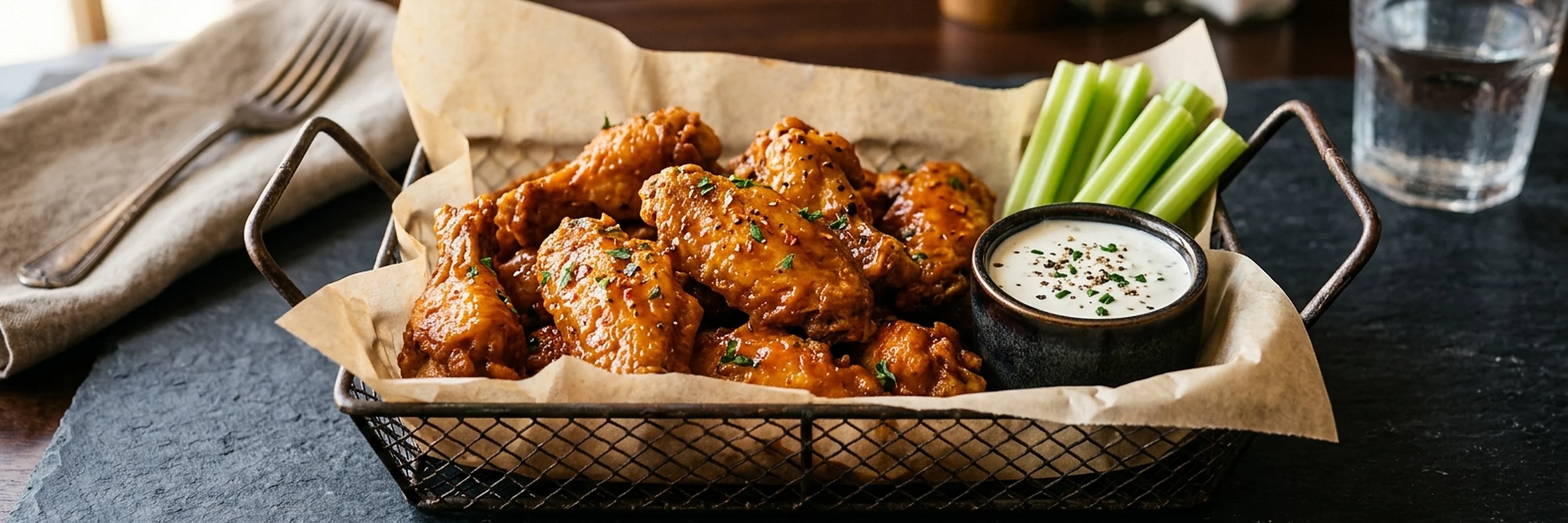
Why did buffalo wings become the definitive American bar food?Buffalo wings became the definitive American bar food because they fulfill the specific functional requirements of bar eating better than virtually any alternative: they're best eaten with your hands (no utensils needed at the bar), they pair exceptionally well with cold beer (fat, salt, and capsaicin drive beer consumption), they can be eaten continuously over a long period without becoming unappetizing, they're shareable (ordered for the table, not individually), they can be customized by heat level to match different preference levels in a group, and they're inexpensive enough to order in volume. No other single food item simultaneously satisfies all these criteria as well as wings. The bar food fit was functional before it was cultural — wings work in bars for real reasons.
A Brief History of Bar Food
Bar food as a category is older than most people realize:
- The 19th-century free lunch tradition: American saloons in the 19th century offered a "free lunch" — salty, filling food (pickled eggs, salt cod, cured meats, cheese) provided to patrons at no additional cost alongside purchased beer. The food was always salty to increase thirst and therefore beer consumption. This free lunch tradition was the first systematic development of bar food as a commercial strategy.
- The free lunch era ends, snack food era begins: Prohibition (1919–1933) disrupted bar food culture, and the post-Prohibition bar rebuilt a different relationship with food — now purchased rather than free, and as a supplement to the bar's primary business rather than a traffic driver. The post-Prohibition bar snack (peanuts, pretzels, chips) reflected the ongoing understanding that salty snacks drive beverage consumption.
- The tavern and pub food tradition: British and Irish pub food (fish and chips, ploughman's lunch, Scotch eggs) provided a model for more substantial bar food that coexisted with drinking. American bars influenced by British/Irish pub tradition (particularly in northeastern cities with large Irish-American populations) developed their own bar food menus in this tradition.
- Sports bar development (1970s–1980s): The sports bar as a distinct establishment type — oriented around multiple televisions showing simultaneous games — developed in the 1970s and accelerated in the 1980s. Sports bars needed food that worked with the specific demand pattern of sports watching: available throughout a 3–4 hour game, shareable, not requiring sustained attention to eat, inexpensive per serving. Buffalo wings arrived exactly when this requirement was crystallized.
Why Buffalo Wings Are Functionally Perfect Bar Food
Each functional requirement of bar food and how wings satisfy it:
- Hand-eating without utensils: Wings require only hands and napkins — no utensils, no careful cutting, no plates that need removal. The bar surface becomes the eating surface. This is compatible with the social setting of a bar where formal dining protocols don't apply and surfaces need to accommodate drinks primarily.
- Beer pairing chemistry: The combination of capsaicin heat (which makes you want to cool down), fat (which coats the mouth and accumulates heat by distributing it across the palate), and salt (which directly increases thirst) creates a feedback loop with cold beer. Each wing increases desire for the next sip; each sip clears the palate for the next wing. This feedback loop is why wings and beer are inseparable as a pairing — it's not cultural convention, it's physiology.
- Extended consumption compatibility: Wings don't become unappetizing as they sit on a plate for 30–60 minutes the way a burger or a hot dog does. Room-temperature or slightly warm wings remain enjoyable throughout a game's duration. The sauce keeps the chicken moist and flavorful across an extended eating period.
- Portion flexibility and shareability: A group can order 12, 20, or 30 wings and distribute them as the group sees fit. There's no individual plating or individual price point — the group orders a communal quantity based on collective appetite and budget. This shareability reduces ordering friction in a group context.
- Heat level customization: A group where one person wants mild and one person wants very hot can order two separate quantities at different heat levels from the same establishment. This customization makes wings the most group-compatible bar food option — no other common bar food accommodates such diverse preference levels in the same order.
The Sports Bar Ecosystem
The sports bar as an ecosystem has specific requirements that wings serve:
- The multiple screen environment: Sports bars with multiple simultaneous games create dispersed audience attention — people are watching different games, having different conversations, at different stages of engagement with the content. Wings accommodate this dispersed attention because they can be consumed without looking at the plate or pausing a conversation meaningfully.
- The grazing eating pattern: Sports watching over 3–4 hours produces a grazing eating pattern rather than a meal eating pattern. Wings are designed for grazing — you can eat 2 wings, stop for 20 minutes, eat 3 more, stop for another 10 minutes, and continue throughout the game. This interrupted consumption pattern suits wings better than most foods.
- The staff efficiency factor: From the restaurant's perspective, wings arrive on a single plate and require minimal table maintenance — no refills, no complex plate management, no utensil replacement. This efficiency means servers can handle more tables simultaneously during peak game-night traffic.
- Alcohol licensing and food requirements: In many jurisdictions, establishments with liquor licenses must demonstrate they are "primarily a food service establishment" or serve substantial food alongside alcohol. Wings allow bars to satisfy this requirement cost-effectively while generating additional revenue beyond the beverage business.
| Bar Food Criterion | Wings | Nachos | Burger | Pizza Slice |
|---|---|---|---|---|
| Hand-edible without utensils | Yes | Yes | Technically yes | Yes |
| Extends beer consumption | Excellent | Good | Moderate | Good |
| Shareable from communal portion | Yes | Yes | No | Yes |
| Customizable by preference | Excellent (heat levels) | Good | Moderate | Moderate |
| Eatable while distracted | Excellent | Good | Poor | Good |
| Stays good for 60+ minutes | Good | Poor (soggy) | Poor | Moderate |
The Economics of Bar Food and Wings
Understanding bar food economics explains why wings are central to sports bar business models:
- The beverage margin driver: Food margins in bars are typically lower than beverage margins. A bar's primary profit center is alcohol, not food. Bar food is evaluated partly as a traffic driver and partly as a beverage consumption enhancer rather than as a standalone profit center. Wings' exceptional pairing with beer means they drive more beverage consumption per food dollar spent than most alternatives.
- The wing night special economics: Wing night specials (discounted wings on specific nights) are a well-established traffic-driving promotion format. The wings themselves may be offered at or below cost on promotion nights — the profit comes from beverage sales generated by the increased traffic. The specific calculation: if a table of four buys $15 of promotional wings and $60 of beer, the net margin is positive even if the food is at cost.
- Commodity wing prices and restaurant volatility: Chicken wing prices are highly volatile — they spiked dramatically during COVID-era supply disruptions (2020–2022), creating financial stress for wing-dependent restaurants. The "boneless wing" category partially emerged as a response to commodity price volatility — boneless wings use less expensive breast meat, providing a more stable cost basis than traditional bone-in wings.
- Wings as anchor product: For wing-specialized chains (Buffalo Wild Wings, Wingstop, Wing Zone), wings function as the anchor product around which the entire business model is built. These chains invest in the wing experience (sauce lineup, fry quality, service protocols) in a way that commodity restaurants can't justify for a side item.
💡 Bar Food Quality Hierarchy
Not all bar food is equal in quality consistency. Wings are among the more forgiving bar foods to prepare well in volume — the sauce hides imperfections that would be obvious in other preparations, the format allows batch cooking, and the customer's low-light, distracted attention is more forgiving than a restaurant dining context. The highest quality bar food experiences tend to be at establishments that specialize in their bar food rather than treating it as an afterthought. For wings specifically, the establishments that take wing quality seriously — maintaining oil temperature, applying sauce fresh, offering genuinely complex sauce lineups — are identifiable by asking bartenders whether they make their sauces in-house and how frequently they change their frying oil.