Quick Answer
What is the Anchor Bar and why is it historically significant?The Anchor Bar at 1047 Main Street, Buffalo, New York is the restaurant where buffalo wings were created in 1964 by Teressa Bellissimo. Frank Bellissimo purchased the bar in 1935; the establishment had been a neighborhood bar and restaurant for nearly 30 years when his wife Teressa created the dish that would make the location internationally known. The Anchor Bar is to buffalo wings what Starbucks's first location is to coffee culture — the origin point that defined a culinary tradition. It continues to operate at the same location, serving wings under the original sauce recipe (now commercially available), and welcomes thousands of food tourists annually.
The Bellissimo Family
The Anchor Bar's story is a story of Italian-American immigrant family history. Frank Bellissimo, a native of Calabria, Italy, came to the United States and eventually settled in Buffalo, New York. He purchased the bar at 1047 Main Street in 1935 — a working-class neighborhood establishment that served the surrounding community.
Frank and his wife Teressa ran the bar and kitchen together. Teressa was the cook — described by family accounts as inventive and instinctive in the kitchen, willing to improvise when circumstances required. Frank managed the bar operations and customer relations. Their son Dominic worked in the establishment and plays a role in the origin story depending on which version you hear.
By the 1960s, the Anchor Bar had been a Main Street Buffalo institution for nearly 30 years. It was known as a reliable neighborhood spot, not as a culinary destination. The 1964 invention changed that, though the national recognition would take years to develop.
The Night Buffalo Wings Were Created
The specific date most commonly given for the first buffalo wing is October 3, 1964, though some accounts give other dates in that period. The generally accepted version of events:
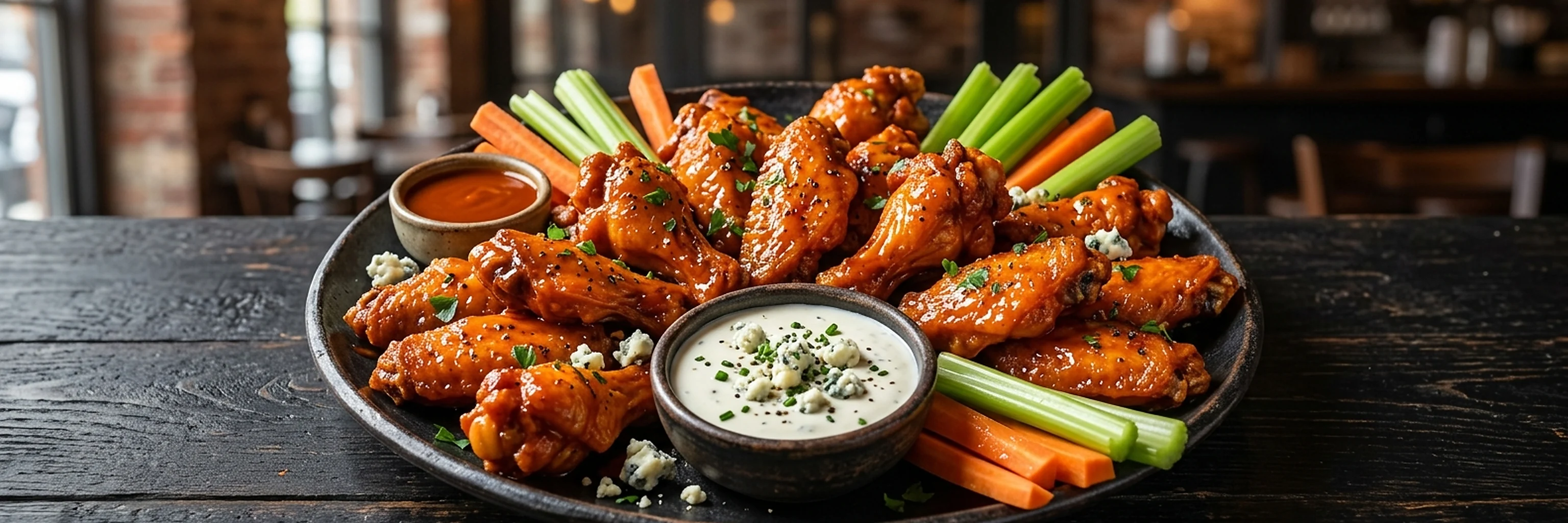
The Anchor Bar received a delivery of chicken wings — the least valued portion of the chicken, used primarily for stock. Teressa Bellissimo, rather than use them for stock, deep-fried the wing sections and dressed them with a mixture of Frank's RedHot cayenne pepper sauce and melted butter. She served them with blue cheese dressing (a local staple in Western New York) and celery stalks.
The response was immediate and enthusiastic. The combination of crispy fried wings, tangy-spicy-rich sauce, cooling blue cheese, and crunchy celery was immediately compelling. Within weeks, buffalo wings had become a staple menu item at the Anchor Bar.
💡 The Blue Cheese and Celery Tradition
The specific accompaniments Teressa chose — blue cheese dressing and celery stalks — became as canonical as the wings themselves in Buffalo. The blue cheese was likely chosen because it was already available at the bar for other uses; the celery was practical, cheap, and refreshing. The functional chemistry is sound: blue cheese's fat and casein protein bind capsaicin; celery's water content and slight bitterness cleanse the palate. Whether Teressa knew the science or just made a sensible choice doesn't change the result — the pairing is genuinely well-designed.
Growth, Recognition, and the Buffalo Wing Declaration
Recognition came gradually:
- 1977: The New York Times features the Anchor Bar specifically in a piece on buffalo wings — the paper's first substantial coverage of the dish. This brought the first wave of food tourists from outside Western New York.
- 1980: The City of Buffalo officially declares July 29 "Chicken Wing Day" at a ceremony at the Anchor Bar. The declaration was partly ceremonial civic pride, partly a recognition that the dish had become genuinely significant to the city's identity.
- 1983: New York Governor Mario Cuomo declares the Anchor Bar the creator of the original buffalo chicken wing — a formal state-level recognition that cemented the historical record.
- 1990s: As buffalo wings became a national phenomenon through chain restaurant expansion, food writers and culinary historians increasingly referenced the Anchor Bar as the origin. The restaurant's volume of out-of-town visitors increased substantially.
The Anchor Bar Today
The Anchor Bar continues to operate at 1047 Main Street in Buffalo as of 2026. Key facts about its current operation:
- The original Main Street location is a pilgrimage destination for buffalo wing enthusiasts — the restaurant actively markets its historical significance and welcomes the food tourism it generates
- The Anchor Bar sauce is commercially available in retail stores — marketed as "The Original" buffalo wing sauce and available in original, medium, hot, and BBQ varieties
- The restaurant has expanded beyond the original location — there are franchise Anchor Bar locations in other cities and countries, though purists distinguish these from the original Main Street establishment
- The interior retains elements of the original bar environment alongside signage, photos, and memorabilia documenting the wing's history and the restaurant's recognition over the decades
- Wing quality debates persist — some Buffalo locals consider Duff's to make better wings today, and food media has periodically run side-by-side comparisons that don't always favor the Anchor Bar. This is largely irrelevant to its historical significance.
The Cultural Legacy
The Anchor Bar's legacy extends well beyond the specific restaurant:
- Buffalo's culinary identity: Buffalo, New York is a medium-sized industrial city that wouldn't typically register as a significant culinary origin point. The buffalo wing has given the city a globally recognized food claim that defines it culturally in a way few cities have. Buffalo is not just "that place near Niagara Falls" — it's the city that invented buffalo wings.
- A $4+ billion industry: The sale of Frank's RedHot to Reckitt Benckiser in 2012 for approximately $4.2 billion (later transferred to McCormick) demonstrates the market scale that one bar's innovation has generated. The broader market for wings, buffalo sauce, and related products is a multi-billion dollar annual industry.
- Culinary innovation template: The story of the Anchor Bar as culinary origin — a practical solution to a supply problem that became a beloved dish — represents a common pattern in culinary history. Kitchen improvisation from necessity or accident that discovers something genuinely excellent is a recurring theme from Worcestershire sauce to chocolate chip cookies.
- The Teressa Bellissimo recognition gap: For decades, the dish was attributed to the Anchor Bar generically or to Frank Bellissimo specifically. More recent food history writing has appropriately credited Teressa as the inventor. Her specific culinary innovation created the dish; the restaurant provided the context.